Columbia’s Michael Woodford Wins 2026 Nobel Memorial Prize in Economics
Woodford receives Sveriges Riksbank Prize in Economic Sciences, along with Robert E. Hall of Stanford University, for microeconomic foundations of macroeconomic stabilization.
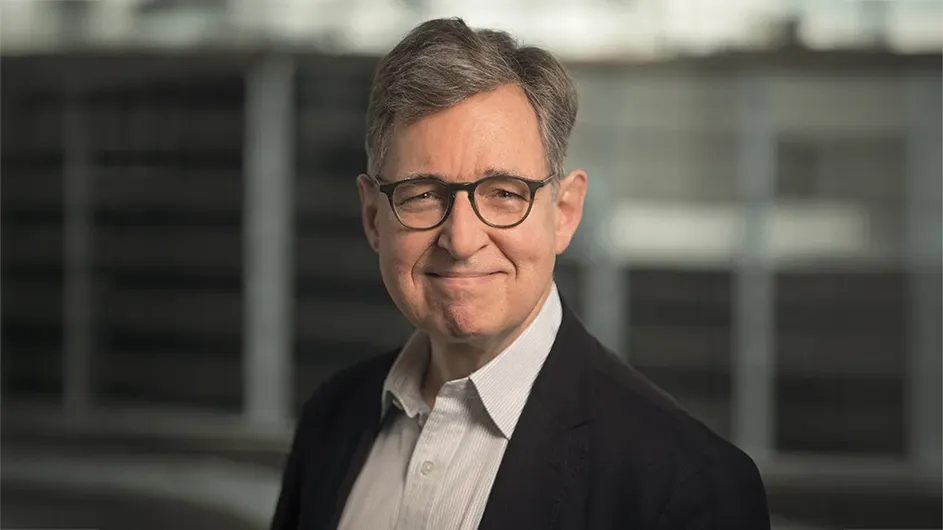
The Royal Swedish Academy of Sciences today awarded the Sveriges Riksbank Prize in Economic Sciences in Memory of Alfred Nobel 2026 to Michael Woodford, the John Bates Clark Professor of Political Economy at Columbia University, along with Robert E. Hall of Stanford for microeconomic foundations of macroeconomic stabilization.
In a phone call from the Academy during the announcement and press conference, Woodward was clearly elated by the news. “It’s a tremendous honor. It’s a surprise. But I’m feeling very good about it,” he said.
“I offer my deepest congratulations to Michael Woodford on this tremendous honor. What a tribute to his groundbreaking work alongside Robert E. Hall that has fundamentally reshaped the theoretical foundations of stabilization policy and provided us with the tools to navigate economic upturns and downturns more effectively,” said Columbia University President Jennifer L. Mnookin.
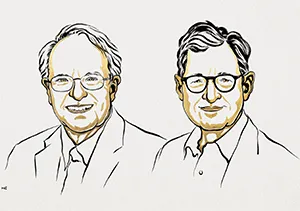
According to the Nobel Prize website, Woodford and Hall “demonstrated how economic models could be reconstructed to revitalise stabilisation policy. Rather than basing the models on statistical links between macroeconomic variables, such as inflation, production and consumption, they chose to build them on a microeconomic foundation. This encompasses an understanding for how the total mass of individual households and businesses affect the economy through their actions.” Using these models, central banks and finance ministries around the world have become better positioned to stimulate or slow down the economy at the right time to provide stability and to help avoid lengthy boom and bust cycles.
Woodford is the 16th Columbian to receive this prize in economics, and the University’s 89th Nobel laureate.
“It was an attempt to improve the foundations for discussion of economic policy and therefore to contribute to both the management of the economy and to public understanding,” Woodford said over the phone during the announcement of the prize. “One of the themes of my work is that government authorities shouldn’t view stabilization of the economy as an exercise that is simply conducted by people pulling levers to control the economy independently of what people in the economy understand about this.
“My work has stressed that the understanding of the people who are in the markets and making decisions about spending and so on, and that their expectations and their understanding of what policy is likely to be in the future are actually crucial to the effects of the policy. And so, creating a framework that allows governments to talk to the public about what they’re doing is also important. That was one of the key goals of trying to develop an analytics framework; it was not simply to use it on people but to also talk to the people about why the things that are being done are being done.”
Photos From a Day of Celebration
Snapshots from Oct. 12, 2016, the day Woodford, John Bates Clark Professor of Political Economy, was awarded the Nobel Memorial Prize in Economic Sciences.
Image Carousel with 7 slides
A carousel is a rotating set of images. Use the previous and next buttons to change the displayed slide
-
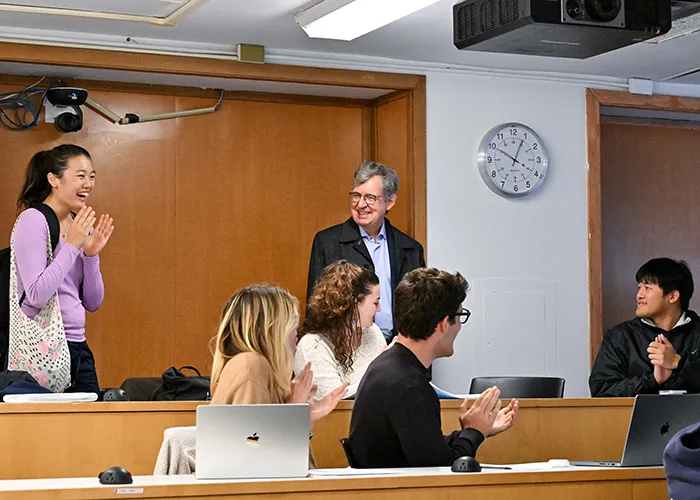
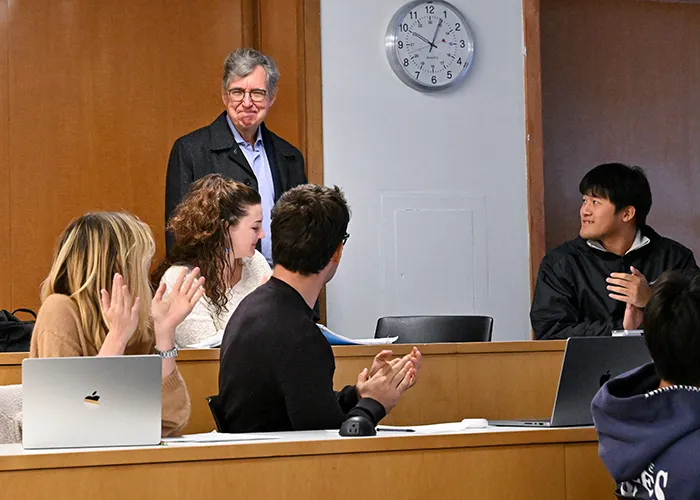
Slide 1: Nobel Memorial Prize in Economic Sciences winner Michael Woodford enters his Cognitive Mechanisms and Economic Behavior classroom in Uris Hall to cheers and applause from his students. Photo by Diane Bondareff/Columbia University.
-
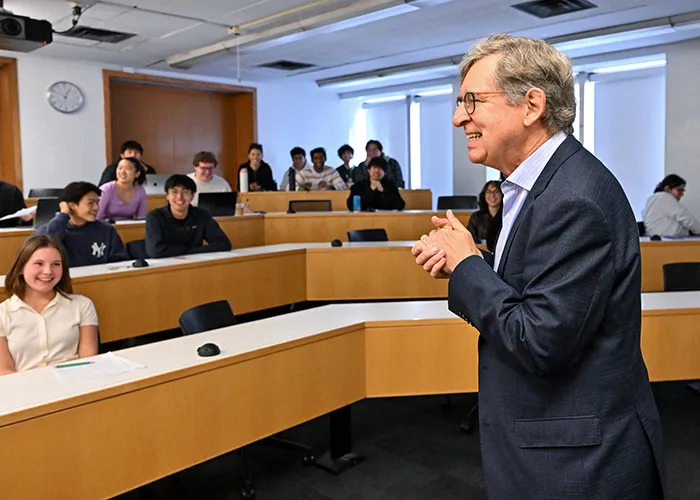
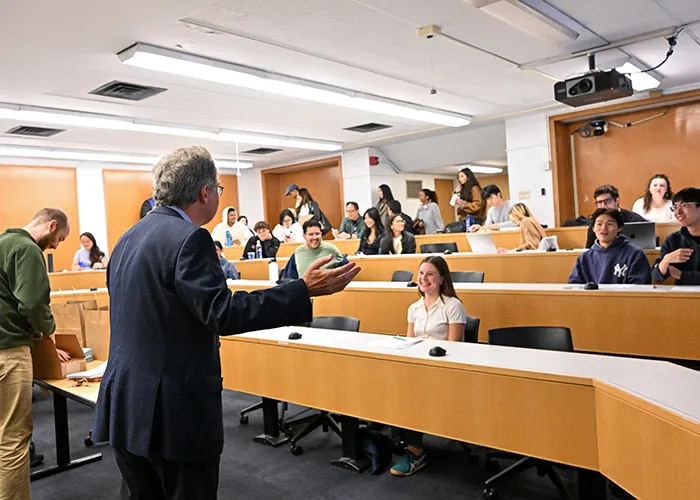
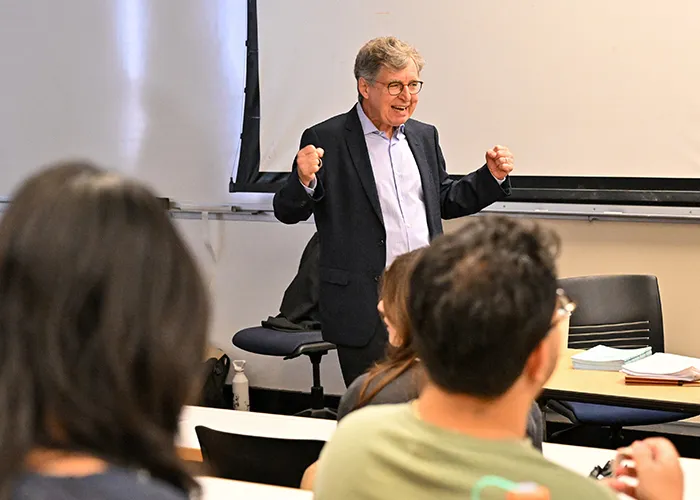
Slide 2: Nobel Memorial Prize in Economic Sciences winner Michael Woodford prepares to give an exam in his Cognitive Mechanisms and Economic Behavior course. Photo by Diane Bondareff/Columbia University.
-
Slide 3: Nobel Memorial Prize in Economic Sciences winner Michael Woodford enters his Cognitive Mechanisms and Economic Behavior classroom in Uris Hall to cheers and applause from his students. Photo by Diane Bondareff/Columbia University.
-
Slide 4: Nobel Memorial Prize in Economic Sciences winner Michael Woodford prepares to give an exam in his Cognitive Mechanisms and Economic Behavior course. Photo by Diane Bondareff/Columbia University.
-
Slide 5: Nobel Memorial Prize in Economic Sciences winner Michael Woodford prepares to give an exam in his Cognitive Mechanisms and Economic Behavior course. Photo by Diane Bondareff/Columbia University.
-
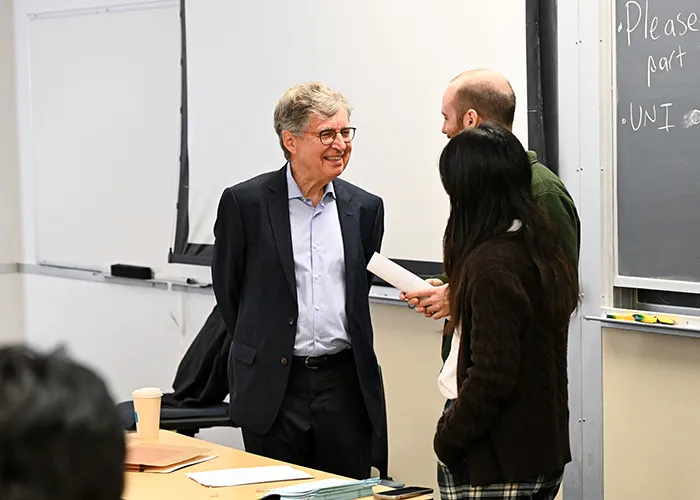
Slide 6: Nobel Memorial Prize in Economic Sciences winner Michael Woodford speaks with his Teaching Assistants in his Cognitive Mechanisms and Economic Behavior course. Photo by Diane Bondareff/Columbia University.
-
Slide 7: Nobel Memorial Prize in Economic Sciences winner Michael Woodford. Photo by Diane Bondareff/Columbia University.
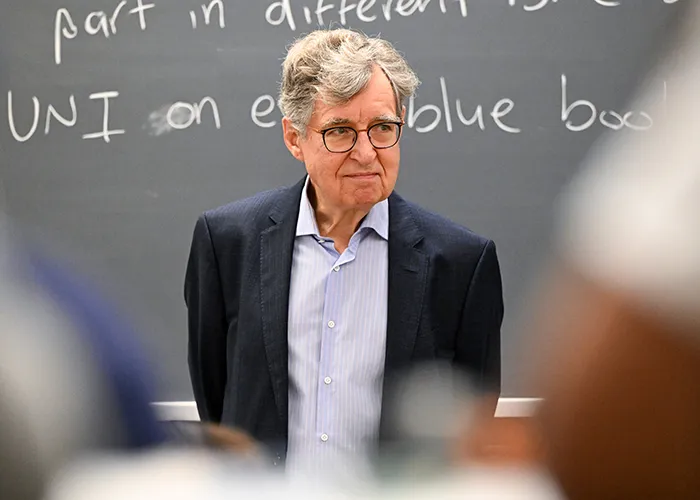
The Sveriges Riksbank (Sweden’s central bank) established the Sveriges Riksbank Prize in Economic Sciences in Memory of Alfred Nobel in 1968. The prize is based on a donation received by the Nobel Foundation from Sveriges Riksbank on the occasion of the bank’s 300th anniversary. The prize amount is the same as for the Nobel Prizes and is paid by the Riksbank. The prize in economic sciences is awarded by the Royal Swedish Academy of Sciences, Stockholm, Sweden, according to the same principles as for the Nobel Prizes that have been awarded since 1901.
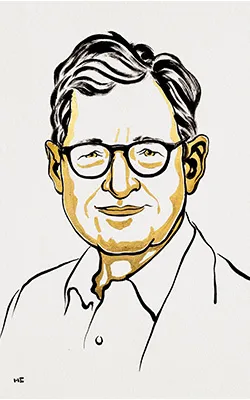
Woodford began his academic career at Columbia as an assistant professor in the Department of Economics in 1984. He held positions at the University of Chicago and Princeton University before returning to Columbia in 2004. He has been both a MacArthur Fellow and a Guggenheim Fellow. He is also an elected fellow of the American Academy of Arts and Sciences, as well as a fellow of the Econometric Society, of the Society for the Advancement of Economic Theory, and of the Society for Economic Measurement.
He has earned numerous awards in economics, including the Deutsche Bank Prize in Financial Economics in 2007, the Banque de France/TSE Prize in Monetary Economics in 2018, and in 2024, he was the recipient of the Erwin Plein Nemmers Prize in Economics.
This article will be updated throughout the day.